Official Strategic Document
Feasibility Study: EduPreneurship Program
Location: Mumbai, India
Business Type: Hybrid (Education + Enterprise Incubation)
1. Executive Summary
The EduPreneurship Program is a pioneering seven-year educational and entrepreneurial initiative aimed at youth aged 15 to 22. Integrating formal academics with enterprise creation, the program mandates that every participant legally register a business and achieve at least $1 million in cumulative revenue to graduate.
Graduates will hold recognized academic degrees, vocational and international certifications, and equity in functioning companies. Financial sustainability is achieved via equity sharing and an operational model designed for long-term impact.
2. Market Analysis
India’s demographic dividend—over 600 million individuals under age 25—presents vast potential for educational reform. Traditional systems often fail to cultivate job creators, creating demand for practical, skills-based programs.
Mumbai, as India’s commercial capital, offers an ideal launchpad due to its youthful population, vibrant startup culture, and investor network. Supported by government reforms such as NEP 2020, the EduPreneurship Program is well-positioned to meet a critical need.
Target Segments:
Students (15–22 years), post-10th or 12th grade
Parents seeking measurable ROI on education
International students from Asia, GCC, and Africa
3. Organizational and Ownership Structure
Managed by EduPreneur Partnership Corporation (EPC), each student business is established as a sub-entity. The equity structure ensures shared responsibility and long-term alignment:
Student: 36% (CEO role, decision-making authority)
Bank/Investor: 35% (Funding partner)
CSR/Charity/Institute Social Dept: 10% (Impact governance)
Institute: 19% (Support services provider)
This framework balances entrepreneurial freedom with institutional support.
4. Product/Service Description
The EduPreneurship Program includes:
Company registration and MVP development
Blended curriculum in business, tech, and leadership
Global certifications and academic degrees
International internships, business tours, and mentorship
Co-working access and digital business tools
Specialization Tracks:
Cybersecurity
AI & Automation
Trading & E-commerce
Digital Marketing
Contracting & Manufacturing
5. Operational Plan
Years 1–2:
Tuition: $22,000/year/student
Activities: Training, mentorship, startup launch
Years 3–7:
Tuition-free, equity-based model
Business operations and investment readiness
Legal, audit, and international exposure
Delivery Model: On-site bootcamps, virtual learning platforms, and AI dashboards for tracking.
6. Marketing and Sales Strategy
Channels:
Digital Ads (YouTube, Google, Instagram)
Influencer marketing (founders, youth icons)
School-based outreach and events
Enrollment Funnel:
Application → Interview → Screening → Admission
Promotions:
Scholarships for girls, early applicants, and competition winners
7. SWOT Analysis
Strengths:
Unique model of business ownership through education
International exposure and real-world skills
High ROI and recurring institutional revenue
Weaknesses:
High expectations for student outcomes
Legal and operational complexity
Opportunities:
Expansion to new regions
Collaborations with EdTech firms and universities
Threats:
Economic fluctuations
Regulatory changes in education or startups
8. Financial Projections
Initial Capital Requirement: $20,000
Years 1–2:
Revenue: 20 students × $22,000 × 2 = $880,000
Operating Costs: ~$792,000
Net Surplus: ~$88,000 (10% margin)
Years 3–7:
Projected return from 10 successful ventures:
$1M revenue × 36% equity = $360,000 per student
Total from 10 students = $3.6 million
9. Risk Assessment
RiskMitigation StrategyUnderperformance by studentPersonalized mentoring, progress monitoringInvestor attritionDiverse funding sources, recurring cohort intakeLegal complicationsCentralized legal and compliance supportDropoutsBuyback clauses, equity redistribution
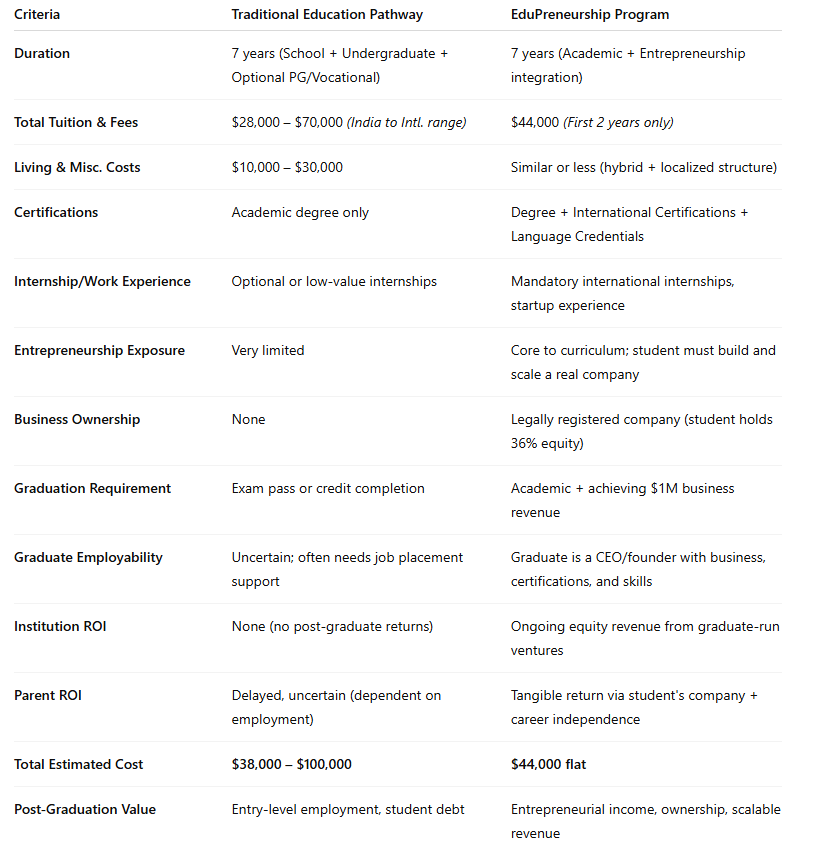
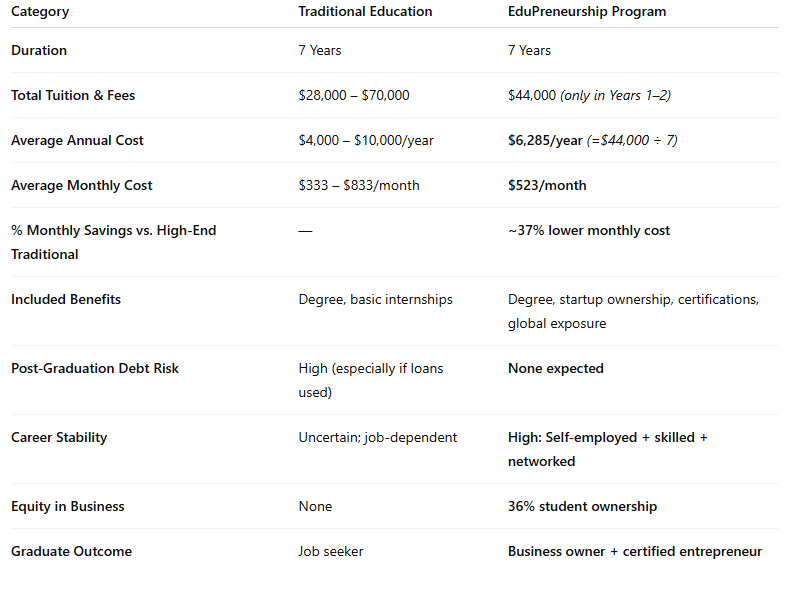
7-Year Educational Cost & Value Comparison
Notes:
EduPreneurship offers comparable or lower upfront cost, but multiples more in long-term value.
Traditional models often lead to delayed ROI, while EduPreneurship aims for income generation during the study period.
Program outcomes (company ownership, international exposure) significantly exceed industry norms.
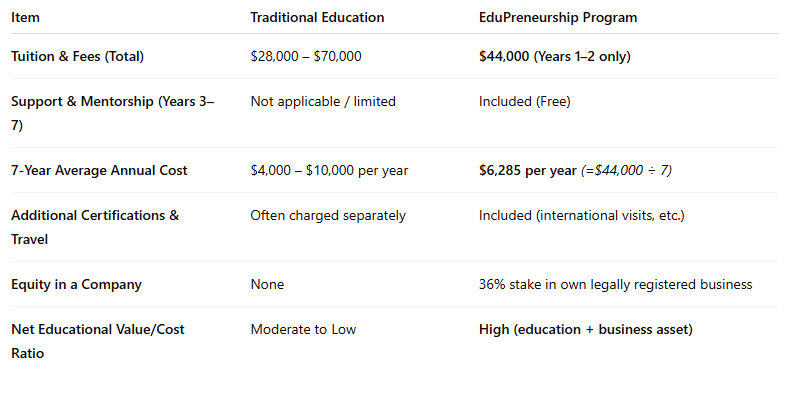
Adjusted Cost Comparison:
7-Year Average Per Student
Summary:
EduPreneurship's 7-year average cost per year = $6,285, with all essential academic, startup, and global exposure included.
Compared to traditional models (especially international or private colleges), this program delivers substantial cost efficiency and higher ROI potential.
Highlights
EduPreneurship saves up to 37% monthly compared to private/university models over 7 years.
It shifts from “education for employment” to “education through entrepreneurship,” ensuring career stability via business ownership.
Students graduate with a business asset, global exposure, and no debt.
7-Year Education Investment Comparison: Traditional vs. EduPreneurship
10. Conclusion and Recommendations
The EduPreneurship Program offers a revolutionary blend of education and enterprise creation, addressing key gaps in traditional systems. Its equity-based model ensures scalability, sustainability, and deep social impact.
Recommendations:
Establish legal framework and mentor board by August 2025
Raise seed funding for Q3 2025 operations
Launch admissions by September 2025
Limit Year 1 cohort to 20 students to optimize pilot execution